skip to main |
skip to sidebar
(This article was originally featured in "St. Louis Game Time," Vol. 4 No. 10, November 21, 2008 in "Tomorrow's Blues with Brian Weidler")In our last report, we took a look at some European prospects that could be considered the high end of the Blues' system across the pond -- Lars Eller, Simon Hjalmarsson, and Kristoffer Berglund.
Tonight, we'll focus on the three remaining prospects playing in Europe -- slick center Jori Lehtera with Tappara Tampere of the SM-Liiga, or Finnish Elite League; goaltender Hannu "Ears" Toivonen, playing in the same city as Lehtera with Ilves Tampere; and goaltender Reto Berra, plying his trade with HC Davos of the Swiss Nationalliga-A.
Jori Lehtera, C, shoots L, 6'2, 191, born Dec. 23, 1987 in Helsinki, Finland.
 The Blues' fourth selection (65th overall) in 2008, Lehtera is an older prospect just a few weeks shy of his 21st birthday, but is more physically and mentally mature than the average prospect in the system.
A very skilled playmaker, Lehtera is a player who will almost always look to pass before taking the shot. His career numbers in the SM-Liiga bear that out: 107 games played through November 18th, 22 goals, 47 assists. Lehtera has the knack of being able to find his wingers from anywhere on the ice, and is most effective when he has the puck and can control the pace of the game.
The downside to Lehtera is that, at age 21, what you see is what you get for the most part. He will probably not ever develop a real goal-scorer's touch, but he can still make a good living setting up the scorers. Naturally, he will have to be placed on a line with at least one first-rate finisher in order to be most effective at utilizing his abilities; a checking-line role won't take full advantage of his playmaking abilities, although Lehtera is an adequate defensive presence. He is also not a physical player, despite having decent size, and will need to get stronger in order to fight through checks and big hits.
Last year was a breakout season for Lehtera, who finished with 13-29-42 totals in 54 games for Tappara ("battle axe" in Finnish). The Helsinki native also finished with a solid plus-7 mark, and only 22 minutes in penalty time. Tappara failed to make the SM-Liiga playoffs last season, however, and appear to be headed for a similar fate this year with an 8-14-3 record and 13th place in the 14-team league with almost half the regular season (runkosarja) played.
Lehtera is currently leading Tappara in scoring with 3-12-15 numbers in 25 games, but he has been held off the scoresheet in his last five games, and has not scored a goal since Oct. 30 vs. Lukko. This will be only his second full season in the SM-Liiga, so calling this year a sophomore slump is probably accurate.
Tappara has Lehtera under contract through the 2009-10 season, and the Blues do not appear to be in any hurry at this point to buy out his last year and bring him across the pond. That may change, however, if the Blues' forwards continue to lose man-games to injury.
Hannu Toivonen, G, catches R, 6'2, 200, born May 18, 1984 in Kalvola, Finland.
 To say that the 2007-08 season was a disaster for "Ears" would be an understatement.
Toivonen appeared in 23 games for the Blues last season, managing only a 6-10-5 record in 1202 minutes played. 69 goals against on 566 shots equaled a 3.44 GAA and an 87.8% save percentage. Things weren't a whole lot better during a mid-season assignment to Peoria, where Toivonen was 6-4-0 in 11 games, with 33 goals against on 283 shots for a 3.17 GAA and an 88.3% save percentage.
Confidence has always been an issue with Toivonen, going back to his days with the Boston Bruins' organization. After two seasons in the AHL with Providence in 2003-04 and 2004-05, Toivonen was 44-34-7 with nine shutouts, a 2.15 GAA and a 92.7% save percentage. He spent the entire 2005-06 season in Boston, and was 9-5-4 in 20 games played with one shutout, a 2.63 GAA and a 91.4% save percentage, and seemed to be on the brink of establishing himself as one of the league's up-and-coming young goalies.
The 2006-07 season changed all that. Toivonen struggled with Boston, going 3-9-1 with a 4.23 GAA and 87.5% save percentage in spot duty, and even a 13-13-1 stint in Providence with a 2.37 GAA and 90.9% save percentage didn't restore his confidence sufficiently to keep the Bruins from swapping him to the Blues for reluctant Swede Carl Söderberg.
Toivonen's dismal performance in the St. Louis and Peoria nets last year has prompted him to return home to Finland, where he's currently the number one goalie for Ilves Tampere. His numbers this year are better -- an 8-12-2 record while appearing in all 23 games Ilves has played to date, 60 goals against on 599 shots for a 2.70 GAA and 89.9% save percentage, and one shutout -- but Finland is probably the best place for Toivonen right now considering the logjam the Blues have below the NHL level in goal. The Blues will give Toivonen as much time as he needs to get his confidence back, and if that happens and he is able to return to North America and get back on the path he was on in 2005-06, it's a plus for the organization.
Reto Berra, G, catches L, 6'4, 189, born Jan. 3, 1987 in Bulach, Switzerland.
Berra has been an enigma for the organization since being drafted 106th overall in 2006. He has been reasonably impressive in each of the three Development Camps he has attended in St. Louis, and he has excellent size and skills for the goaltending position, but every year he is returned to Switzerland to play a mere handful of games in a league that's not exactly one of the best or most competitive in Europe.
 Since the 2006-07 season, Berra has played a total of 23 games in the Swiss top league, and has been the backup to a 40-year-old veteran with one club, and to a youngster in his age group for another. This season with HC Davos, Berra has appeared in only five games, sporting a 2-3-0 record, a 2.89 GAA, and an 89.7% save percentage.
Berra's talent is being wasted in Switzerland, but there doesn't seem to be any room for him on either of the North American affiliates, and he probably hasn't played enough, or been seen enough, to be attractive as trade bait. Berra may end up being a textbook example of a player in the wrong place at the wrong time.
Next time in "Tomorrow's Blues," we'll take a look at where the minor-league affiliates are at the quarter pole of the season. Until then, remember... "if we do not prepare for ourselves the role of the hammer, there will be nothing left but that of the anvil." Auf wiedersehen.
(This article was originally featured in "St. Louis Game Time," Vol. 4 No. 9, November 16, 2008 in "Tomorrow's Blues with Brian Weidler")Over the last few years, Sweden and Finland have become a popular stop on the itineraries of the Blues' scouting staff. Since drafting the departed (and unlamented) Christian Backman in the first round of the 1998 Entry Draft, the Blues have drafted eleven players from Sweden, five Finns, and one each from Norway and Denmark. Two of these players (current Blue Patrik Berglund and Dane Lars Eller) were first-rounders, two more (Simon Hjalmarsson and the  reluctant Carl Söderberg) were second-round selections, and three more (2008 pick Jori Lehtera, 2006 pick Jonas Junland, and 2001 pick Tuomas "Who?" Nissinen) were taken in round three. Of course, the fact that both chief scout Jarmo Kekalainen and chief Euro scout Ville Siren are Finns may have something to do with the abundance of Vikings taken by the Blues in recent years... but it's interesting to note that Kekalainen and Siren have drafted only two of their countrymen (Juhamatti Aaltonen and Lehtera) since coming to the Blues in 2003. Also interesting to note is that none of the Scandinavians drafted by the Blues before 2006 are under contract to the organization at present.
Tonight, we'll focus on the three prospects playing in Sweden -- Eller with Frölunda of the Elitserien, or Swedish Elite League; Berglund with Luleå HC, also of the Elitserien; and Hjalmarsson with Borås HC of the Allsvenskan, or the Swedish equivalent to the American League.
A big "thank you" must go to a regular commenter on the Game Day Threads at the Game Time website and all-around good guy, Marcus Pettersson, for his observations "on the ground" of the prospects currently toiling in the land of Gustavus Adolphus and Volvos.
Lars Eller, C/LW, shoots L, 6'1, 198, born May 8, 1989 in Rodovre, Denmark.
 The Blues' first selection (13th overall) in 2007, Eller is considered one of the top prospects in the Blues' system at the moment. A versatile player who is equally proficient at center or left wing, Eller is under contract to the Blues, but is honoring the remainder of his contract with Frölunda, one of the top organizations in Sweden.
Scouting reports on Eller make note of his excellent skating ability, both in terms of breakaway speed and overall mobility. Also of note is Eller's puckhandling ability, his quick release, and creativity on offense. These attributes have served him well in Sweden, allowing him to pile up 29 goals and 77 points in 84 games at the J20 Superelit (Swedish major junior) level, but his success at the junior level has not fully translated to the Elite League level as yet.
In 17 games for Frölunda this year, Eller has three goals and six points, with an even plus/minus and 4 PIM. Respectable for a 19-year-old, but consider that Eller started the year like a house afire, with four points in his first four games, and has only a goal and an assist in 13 games since. Per our source in Sweden, Eller's ice time per game is decreasing, and "(m)any Frölunda fans feel that Eller's development has stagnated some, that he's not making the strides everyone's expecting. Hopefully he has more to give as the season goes on, but right now, he's not NHL material."
It's not just Eller that's slumping, however; it's the entire team. Frölunda, one of the wealthiest and best-staffed clubs in Sweden, is just 7-8-5 in 20 games, good for only ninth place in the 12-team Elitserien.
Kristofer Berglund, D, shoots L, 5'10, 180, born Aug. 12, 1988 in Umea, Sweden.
Selected in the fifth round (125th overall) by the Blues in last summer's Entry Draft, Berglund has been a star in the IF Björklöven system since age 15. Now skating for Luleå HC of the Elitserien, Berglund is a first-rate skater with speed and mobility, as well as a smart player with excellent hockey sense and on-ice vision.
No relation to fellow Blues' draftee Patrik, this Berglund is an offense-minded blueliner with a good shot, excellent stickhandling skills, and an ability to make the first pass out of the defensive zone. He racked up seven goals and 40 points in 68 career games with Björklöven's J20 squad, and posted 4-21-25 totals with the Allsvenskan club last season. This year, in his Elitser ien debut, Berglund is a very respectable 2-5-7 (one SHG,) with 8 PIM and a plus-4 mark as a 19-year-old playing with veterans ten years older than he is (including teammates and former Blues Jaroslav Obsut and Lubos Bartecko).
Per our source in Sweden, Berglund is "considered one of the biggest defensive talents in the country, definitely top 10 among defenders aged 20 and below," and he is popular with the Luleå fans as well as Swedish National Team coach (and former NHLer) Bengt-Åke Gustavsson. Gustavsson, our source notes, "likes (Berglund" a lot, and has invited him to several of the National Team's games."
Like Eller's club (Frölunda), Luleå HC is struggling a bit with an 8-8-4 record in 20 games, good for seventh overall in the Elitserien. Based on his performances to date, Berglund can be expected to help make that record better.
Simon Hjalmarsson (Jahl-mur-son), RW, shoots L, 5'11, 161, born Feb. 1, 1989 in Varnamo, Sweden.
For the Blues, the 2007 NHL Entry Draft may well end up going down in history as their best ever, at least at the top. Their three first-round picks in that draft included Eller, Ian Cole, and current NHLer David Perron, and in the second round they chose Michigan star Aaron Palushaj 44th overall after taking Simon Hjalmarsson with the 39th selection.
 Hjalmarsson, according to our source in Sweden, "has officially emerged as a scoring threat in senior hockey. He's not a dominant player by any means, but he's very fast, hard working, and always looks to get the offense going." His team, Borås HC, started the Allsvenskan season with seven straight losses, but is 3-3-3 since then, and Hjalmarsson leads the way in scoring for the club with 6-8-14 totals and a plus-2 mark in 17 games. He has also won five of eight faceoffs taken (63%), and his six goals include a power-play marker, a shorthanded goal, and a game-winner.
When with Borås HC, Hjalmarsson is lined up most often with Islanders' 2008 draft pick David Ullström, and Atlanta draftee Nicklas Lasu (since assigned to Frölunda's J20 squad), and that Kid Line is considered the team's top line. Hjalmarsson has been out of Borås' lineup recently, skating for the Swedish Junior National Team, and he is expected to play a key role at the U-20 World Juniors next month.
Next time in "Tomorrow's Blues," we'll go back to Europe for a look at the Blues' prospects in Finland and Switzerland. Until then, remember... "if we do not prepare for ourselves the role of the hammer, there will be nothing left but that of the anvil." Auf wiedersehen.
(This article was originally featured in "St. Louis Game Time," Vol. 4 No. 8, November 1, 2008 in "Tomorrow's Blues with Brian Weidler")October was a pretty good month for Davis Payne and the Peoria Rivermen.
With nine games under their belt, and having survived the organizational goalie-go-'round along with the parent club, the Rivermen are a solid 5-3-1-0 for 11 points and the sixth spot in the Western Conference, and fourth place in the West Division behind the Rockford IceHogs (CHI) at 7-1-0-0, Chicago Wolves (ATL) at 5-2-1-1, and Iowa IceHogLogoRipoffs (ANA) at 6-4-0.
The Rivs started October with a pair of tough losses to Iowa in a home-and-home series, but closed out the month on a three-game win streak, capping it off with a 4-2 win over the Quad City Flames on Halloween. Czech import Marek Schwarz went the distance in net for Peoria, stopping 27 of 29 shots against for his first win of the year, improving his AHL record to 1-2-0, and his GAA and save percentage to 4.05 (from 5.13 before Friday night) and 86.0% (from 82.5%).
 Payne's club has 31 goals for, and 27 against, in the nine games played to date, and the power play has been a driving force behind the offense. In 67 chances so far, the Rivermen have 14 goals, which ties them with Rockford for the highest raw goals-for total on the power play. 14 of 67 equals a 20.9% success rate on the power play, good for a sixth-place tie in the league with division rival Milwaukee. In five home games, the Rivermen are scoring at a 25.7% clip with the man advantage (9 of 35), good for sixth place, while away from the friendly confines of Carver Arena, the boys are 5-for-32 for a 15.6% success rate (11th in the AHL).
All in all, not too shabby for a team that's seen a lot of turnover since last season, in the front office and on the ice.
"I think that we've accomplished what we wanted to and addressed the weaknesses of our club from last year," noted Payne. "We didn't feel like the (team) mobility was as good as it needed to be in this league, especially with the way the game is played now. We feel like we've got pretty good mobility on the back end, with the ability to distribute the puck."
"As far as our group up front," Payne continued, "we wanted to have guys that could play the game in all different styles. We feel we're a little bit bigger up front, and we can play a grinding game if necessary, but (we) also have the right ability to finish off plays and we feel we've got a good grit element to our game."
"The concern has been some inconsistent play by some guys early, but that's why we're here (in the AHL)."

Several players have, fortunately, been anything but inconsistent in the early going. 24-year-old Steve Regier, an AHL veteran signed from the Islanders this summer as a free agent, has been "Mr. October" for the Rivermen, with 7-4-11 totals (3 PPG, 2 GWG) in nine games. The 6'4, 195-pound Regier is tied for second in the AHL in goals scored, trailing only Hershey's Alexander Giroux, who has nine.
"He's doing a lot of things well," Payne said. "His first couple of games, it didn't really feel like he was up to speed. But he got past that, and you talk about his last six, seven games, he's been very consistent in all the right areas. He's very conscientious defensively and positionally, he has good speed, good skills, and the ability to make plays. We've been really pleased with him all around; he's provided us with a lot.
Throw in contributions from Julian Talbot (5-4-9, 14 PIM, 4 PPG in nine games), emerging young star Nikolay Lemtyugov (2-7-9, plus-1, 2 PPG), and Dallas import Chris Conner (4-3-7, 2 PIM, 3 PPG in eight games), as well as steady veterans Trent Whitfield (2-5-7) and Cam  Paddock (3 G), and the Rivermen are getting offense from every line so far.
On the blueline, the mobility and puck distribution Payne spoke of has been prominently featured, especially since the assignment of rookie Jonas Junland (who is said to be held in very high regard by Blues' management) and the return of Jeff Woywitka to central Illinois.
Since being sent to Peoria last week, after missing almost six weeks with a broken bone in his right foot, Woywitka has been nothing short of dominant in a Rivermen sweater. In just three games, Woywitka has five assists, is a plus-2, and has been logging big minutes as the de facto number one defenseman in Payne's lineup.
"Obviously, with Jeff Woywitka, he's a guy with great feet (skating ability) and he can really dominate at this level with his feet," said Payne. "He hasn't played much, and his game conditioning may be not there yet, but when he's up and going, he's a premier guy at this level with his ability to skate and defend, move the puck, shoot the puck... he gives us a lot of options back there."
The goaltending has been top-notch for the Rivermen as well in the month of October. Schwarz had a rocky start, but showed there's still a place for him in the organization by preserving a shutout for fellow prospect Ben Bishop while in St. Louis, and by being reassigned to Peoria with the intention of being top dog there for the time being.
 Unheralded Chris Holt came over from the Rangers' organization in midsummer, and got the call from Alaska when the Blues' goaltending stable got bit by the injury bug. His work in a pinch in Peoria (2 GP, 2-0-0, 2.00 GAA, 91.5% save percentage) earned him an NHL contract from the Blues just the other day.
"For a guy that played half a period here in training camp, and played one game in training camp up in Alaska, he's come in here and given us exactly what we needed," Payne commented. "He's solid, he makes big saves when needed; all the saves you expect your guy to make, he was there for us. Doesn't give up a lot of rebounds; he made a couple of miscues on some pucks, but really, he gave up four goals (in a weekend series with Lake Erie), and one went in off of us, off of a faceoff, and that's a pretty good performance against a pretty good offensive group."
Next time in "Tomorrow's Blues," after the road trip, we'll take a look back at the early season for the European prospects. Until then, remember... "if we do not prepare for ourselves the role of the hammer, there will be nothing left but that of the anvil." Auf wiedersehen.
(This article was originally featured in "St. Louis Game Time," Vol. 4 No. 7, October 31, 2008 in "Tomorrow's Blues with Brian Weidler")In the last edition of "Tomorrow's Blues," we caught up with the more high-profile members of the Blues' stable of college prospects. Tonight, we'll take a look at the guys who don't stand out from the crowd quite as much.
There is an entire forward line, plus one, in tonight's crop, plus a converted forward now playing defense. All of the forwards have what the scouts like to call "NHL size," and at least two of them are possible power forwards in the making.
Matthew McCollem (LW, shoots L, 6'1, 205; Blues' 6th pick, 154th overall, in 2006): Something of a dark horse among Blues' prospects, McCollem is a potential home-grown Keith Tkachuk... he has the size, he has the Boston background, and he has the nose for the net.
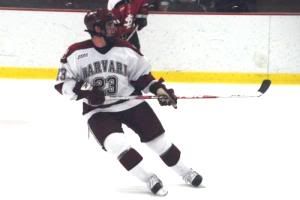 A former captain and scoring leader at one of the most prestigious prep programs in the Boston area (Belmont Hill), McCollem's career at Harvard did not get off to a great start last year (0 G, 3 A, minus-7 in his first 18 games). Once February rolled around, however, McCollem heated up as fast as the weather outside cooled down.
"He got off to a slow start [last year]," Crimson coach and former NHLer Ted Donato said in the US College Hockey Online.com Harvard season preview, "but in the last third or half of the season he was superb. He’s got the physical tools that make him very difficult to stop when he’s on his game."
"Superb" just about covers it when describing McCollem's first spring as a collegian. In his last 13 games, the Somerville, MA native racked up five goals and 11 points, a plus-8 mark, and six minutes in penalty time, leading Harvard to the NCAA East Regional Final before falling to Princeton, one game shy of a Frozen Four appearance.
For the 2007-08 season, McCollem's totals were a very respectable 5-9-14 in 31 games, with a plus-1 and 28 minutes in the sin bin. The Crimson are counting heavily on McCollem to be one of their leaders on offense when they kick off the 2008-09 season on Oct. 31 vs. Lee Stempniak's alma mater, Dartmouth.
Andrew Sackrison (C/W, shoots L, 6'1, 200; Blues' 5th pick, 124th overall, in 2006): The Blues have found a pretty rich vein of talent at Minnesota State - Mankato in recent years, bringing draftee David Backes and free agent Steve Wagner out of school early and into the organization in recent years. The club hopes to continue this tradition with St. Louis Park, MN native Andrew Sackrison.
Another potential power forward for the Blues, Sackrison has bulked up from his draft weight of 178 pounds, and his no-frills game of finishing his checks and working hard on the penalty kill translates well to the NHL style.
McKeens Hockey Prospects website notes that Sackrison is a player that doesn't hesitate to drive to the front of the net, and his excellent balance and strength make him tough to move once he gets there. McKeens also notes that Sackrison is not an elite scorer or playmaker, but is a better-than-average passer with good on-ice vision, and that he "pursues the puck adequately where his fine top gear is commanding in the open ice."
As a freshman at MSU last year, Sackrison rang up six goals and 20 points in 36 games. In the USCHO.com Minnesota State 2008-09 preview, Mavericks coach Troy Jutting calls Sackrison, along with juniors Kael Mouillerat and Geoff Irwin, a player that is "ready to step up from the 20-point plateau and into that 30-point range. And, if you can get five, six kids in that range, I think you can be successful."
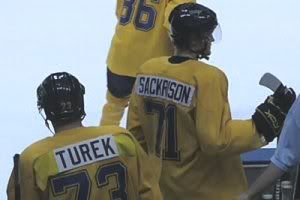 This year, Sackrison has been playing on a line with Irwin and Jason Wiley, and Sackrison assisted on goals by both Wiley and Irwin as the Mavericks split a series with North Dakota last weekend.
Trevor Nill (C, shoots R, 6'2, 185; Blues' 7th pick, 190th overall, in 2007) and Ryan Turek (D, shoots R, 6'0, 185; Blues' 4th pick, 94th overall, in 2006): Both Turek, a junior, and Nill, an incoming freshman, skate for Rick Conley's Michigan State Spartans, and each has a single assist in early-season play. Turek was a member of the 2006-07 national championship team, but did not appear in the final game and only played in one game on Scottrade Center ice during the Frozen Four that year.
Turek was a swingman in junior hockey, playing both defense and center with Omaha of the USHL in his draft year, but has since been converted into a full-time defenseman at Michigan State. McKeens Hockey Prospects website notes that the switch to defense "suit(s) his game better. (Turek) displays good range, as he utilizes his strong stride well to jump and join the offensive attack as well as to cover up a lot of ice while defending." McKeens also notes that the Northville, MI native is "fairly strong with a big frame that he uses well to be tough in front of his crease, neutralize his man along the wall, and to stand up his man at the blueline."
Never an elite scorer even in junior, Turek's next collegiate goal will be his first. He has, however, managed 8 career assists in 71 games to date, and has recovered from a minus-9 mark as a freshman to be a valuable member of the Spartan blueline.
Nill, son of Red Wings' executive and former Blue Jim Nill, developed in and was drafted out of the Detroit Compuware junior program before heading west for a season with the Penticton Panthers of the British Columbia Junior League last year, where he was 5-6-11 with 16 PIM in 53 games.
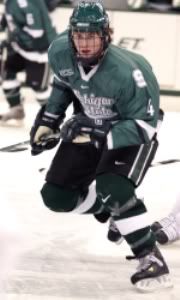 McKeens notes that Nill was "not expected to provide a lot of offense in the early going (at MSU this year), however (he) provides welcome size down the middle and plays a mature game on the defensive side of the puck." His defensive skills include an ability to tie up his man when taking faceoffs, and a regular shift on the penalty kill.
Nill "probably should get a bit more out of his 6-foot-2, 185-pound frame than he currently does," McKeens also notes, and "seems to lack the elite vision with the puck that would allow him to be able to distribute the puck better."
Travis Erstad (C, shoots R, 6'4, 205; Blues' 8th pick, 100th overall, in 2007): Originally scheduled to attend UW-Madison this season, Erstad decided at the 11th hour to return home to Stevens Point and opted to enroll at the hometown branch of the UW system instead. The decision to forego a Division I career to play in Division III doesn't bode well for Erstad's pro future, as only a handful of players have ever been drafted out of a Division III school, and no notable current NHL players have attended one.
UW-SP has played one game so far this season, a 10-0 rout of Northland College. Erstad started the game for the pointers, but managed only one assist out of the 14 awarded on the Pointer goals. Last year with Lincoln of the USHL, Erstad racked up 9-10-19 totals and 104 PIM in 52 games.
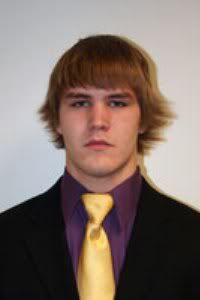 At 6'4, 205, Erstad has the size and the skill set to make an impact no matter what level he plays, but there's some question about the heart, and the willingness to pay the price for a high-level career
Next time in "Tomorrow's Blues," we'll review the first month of the AHL season with Peoria, and have a few words with Rivermen bench boss Davis Payne. Until then, remember... "if we do not prepare for ourselves the role of the hammer, there will be nothing left but that of the anvil." Auf wiedersehen.
(This article was originally featured in "St. Louis Game Time," Vol. 4 No. 6, October 25, 2008 in "Tomorrow's Blues with Brian Weidler")The Blues have a long history of drafting players from the NCAA ranks. Back in the 80's, the usual reasoning was because the team had four years to make a decision on the player, and meanwhile they were developing on someone else's dime. Players like Nelson Emerson, Curtis Joseph, Rod Brind'Amour and Jamal Mayers all joined the Blues' organization after being drafted (or, in Joseph's case, signed as a free agent) out of college programs.
More recently, the Blues have been drafting college players not because they get four free years of development out of the deal, but because the talent level of the colleges has improved drastically. Players like Erik Johnson, Lee Stempniak, David Backes, Steve Wagner, T.J. Oshie, Chris Porter and Ben Bishop have all come to the Blues after college careers... and most of those players turned pro before graduation.
The Blues have a strong crop of prospects in college for the 2008-09 season. In this space, we've already introduced you to Boston University's David Warsofsky and Clarkson goalie Paul Karpowich, both taken by the Blues in last summer's Entry Draft. Tonight, we'll catch up with some of the Blues' previous picks who are developing their game in some of the nation's top programs.
Aaron Palushaj (RW, shoots R, 5'11, 187; Blues' 5th pick, 44th overall, in 2007): Probably the Blues' top prospect in college, Palushaj is the leading scorer for Red Berenson's Michigan Wolverines this year with five goals (including two game-winners) and nine points in five games.
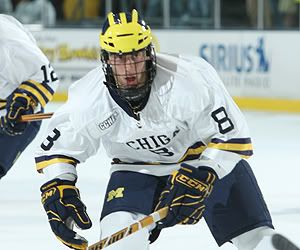 An exceptional all-around player, Palushaj has quick hands and an accurate shot, and is an first-rate passer and set-up man. His 34 assists last season for the Wolverines ranked him first on the team, and second in the nation. Palushaj added ten goals to those helpers, and his 44 total points ranked him third in the nation among freshmen. Those lofty accomplishments, however, couldn't get the Wolverines a championship, nor any significant individual honors for Palushaj, who managed only an honorable mention to the CCHA All-Rookie team.
Last year, Palushaj played second fiddle to seniors Kevin Porter and Chad Kolarik, as well as fellow freshman Max Pacioretty. As a result, Palushaj didn't get the attention of the opposition's top checkers and was able to fly under the radar. This year, Palushaj's no secret to the opposition any more, and he's proving that last year's point totals weren't a result of facing second-unit checking lines.
Ian Cole (D, shoots L, 6'1, 211; Blues' 2nd pick, 18th overall, in 2007): A big, strong, mobile and mistake-free defenseman, Cole was drafted higher at 18th overall than any other Notre Dame player in history. An excellent skater, Cole has a powerful stride that facilitates rapid acceleration, and his recovery speed when getting back on defense is outstanding as well.
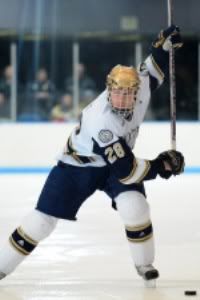 As a freshman last year with the Fighting Irish, Cole put up 8-12-20 totals in 43 games, his highest scoring totals in a single season since his midget days with Detroit Victory Honda. His modest scoring totals while with the US National Team Development Program have led to Cole's offensive game being somewhat under-rated, but last year's point totals -- as well as his 1-3-4 totals in just three games this year -- indicate that this aspect of his game is developing nicely. He makes a nice first pass out of the zone, and possesses solid offensive instincts that let him know when to join the rush and when to hold back.
Cole's physical presence was what led the Blues to rank him as highly as they did, and he continues to play a rock-solid physical game at the next level. Strong as an ox, Cole also has the endurance to log big minutes, and can either muscle an opponent off the puck with ease or lay them out with a board-rattling check.
Nearly a generation ago (has it really been that long), the Blues had a big, physical defenseman who had a solid offensive game, was a rock on defense, and was a leader on and off the ice. Scott Stevens wasn't drafted or developed by the Blues, and only wore the 'Note for one season in his Hall of Fame career. While it's still too early to start mentioning Cole in the same breath with Stevens, the Blues and their fans have good reasons to hope that they can grow their own Stevens almost twenty years after losing the original.
Cade Fairchild (D, shoots L, 5'10, 186; Blues' 7th pick, 96th overall, in 2007): Not big or physical, Fairchild's game is all about offense. He stepped in as the QB of the Minnesota power play last year, and helped the Golden Gophers to a 13.0% conversion rate (25/193) with the man advantage.
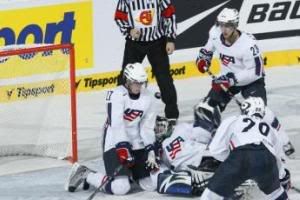 Fairchild can generate offense in the transition game with tape-to-tape breakout passes, and is able to make quick, no-look feeds even while on the move. These skills helped Fairchild to a 2-13-15 scoring line last year, but his minus-4 mark points to his issues in the defensive end.
The McKeens Hockey Prospects website describes Fairchild as "a defensive liability that allows his man to get a step on him and go in clean to the net with scary regularity," and notes that his "lack of strength is most evident around his net, as he's easily out-muscled for position." To his credit, Fairchild has worked on those defensive shortcomings, and is currently a plus-2 for the Gophers. McKeens sums up Fairchild's potential by noting that he has "ability with the puck that you cannot teach, but he will need to bulk up and improve defensively to take the next step."
Jay Barriball (LW, shoots L, 5'9, 155; acquired in trade from San Jose, Feb. 27, 2007): Despite his lack of size, Barriball has a great big skill set, and is able to operate in traffic even at 5'9, 155. The Prior Lake, Minnesota native is now in his third year with the Golden Gophers, and is off to a decent start with one goal (a game-winner vs. St. Cloud State on Oct. 18) in two games.
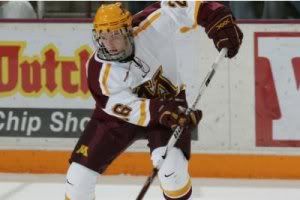 Entering this season, Barriball has 26 goals and 64 points in two seasons at the NCAA Division 1 level, and has had a couple of reasonably impressive showings at the Blues' Development Camp in 2007 and this year. Barriball is a decent skater with great puckhandling ability, and battles hard with and without the puck. He is also defensively aware, uses his speed to come back and help out in his own end, and his pucks skills allow him to create turnovers on defense.
His size will always be a strike against him, but as long as there's a place for skill in the NHL, Barriball will have a shot.
Next time in "Tomorrow's Blues," we'll take a look at the rest of the Blues' college prospects, and see where all the prospects are after the first month of play. Until then, remember... "if we do not prepare for ourselves the role of the hammer, there will be nothing left but that of the anvil." Auf wiedersehen.
(This article was originally featured in "St. Louis Game Time," Vol. 4 No. 5, October 24, 2008 in "Tomorrow's Blues with Brian Weidler")The Blues are currently ranked the number one developmental organization in the NHL by the staff of the Hockey's Future website, in large part on the strength of their defense prospects. Three of the six players chosen by the Blues in the first round of the NHL Entry Draft over the last three seasons have been defensemen, and in those drafts the Blues have chosen a total of seven defensemen with picks in the top 100 each year.
Of course, a huge chunk of the Blues' future on defense is currently on the shelf, with first-rounders Erik Johnson (golf cart knee) and Alex Pietrangelo (cheap shot from Ryan Hollweg) on the injured list, and 2006 second-rounder Jonas Junland just about to return from a pre-season injury.
The loss of these players' services has resulted in players remaining in St. Louis this year -- Roman Pola'k, Steve Wagner, Jeff Woywitka and veteran Mike Weaver -- who would likely have otherwise been assigned to Peoria. Woywitka has since been sent down, and will play tonight for the Rivermen, but his presence in St. Louis has been a contributing factor to Peoria GM and Blues' Pro Scouting Director Kevin McDonald having to scrounge up defensemen on AHL contracts and pro tryouts in order to fill gaps in the lineup.
None of the three Blues-contracted defensemen currently in Peoria have scored a goal yet, and none have more than a single assist. All, however, bring something a little different to the table in terms of their experience and their style of play.
The youngest of this trio is rookie T.J. Fast, a former second-round pick of the L.A. Kings in 2005. Acquired by the Blues this summer in exchange for a fifth-round pick in the 2009 Entry Draft, the 6'2, 190-pound Fast is what his name implies, described by the McKeens Hockey Prospects website as "an agile and compact skater." The Calgary native left the University of Denver midway through his sophomore season in 2006-07 and landed with the Tri-City Americans of the WHL, where he blossomed into an offensive force at that level with 20 goals and 76 points in 97 career games.
Fast has been a healthy scratch for Peoria in several games thus far, largely due to some issues in the defensive end of the rink. McKeens correspondent Max Geise described him earlier this month as "a train-wreck defensively that runs around and chases after the puck while getting trapped up-ice and out of position routinely." Fast has a lot of skill, however, and will be given every chance to make the transition from the major junior game to the AHL.
Second-year man Alexander Hellström had a promising rookie season last year with Peoria, where the big (6'2, 207) Swede managed more goals (3) as a North American rookie than he scored in three seasons with IF Björklöven of the Allsvenskan from 2204-05 to 2006-07. Injuries limited Hellström's season to just 35 games, however, so the big southpaw is looking to stay healthy and continue his progress this year.
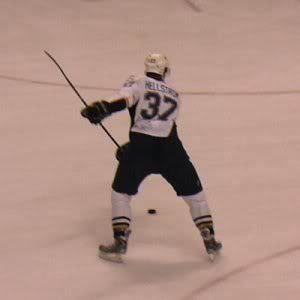 McKeens describes Hellström as a "stay-at-home defenseman with a blossoming game in his own end." Strong as an ox, Hellström establishes himself in front of his net and is effective at keeping that area clear for his goalie. He's also a pretty good penalty killer, makes a good first pass, and is a very good shot blocker. All in all, as McKeens notes, Hellström is "a much more polished defender (this year) compared to last year."
The last of the Blues-contracted players in Peoria is veteran Andy Wozniewski. Signed as a free agent by the Blues this summer, the 28-year-old journeyman provides NHL-caliber depth for emergencies, and solid veteran leadership on Peoria's blueline. Wozniewski has great size at 6'5, 225 pounds, but he has yet to learn how to use that size effectively enough to keep a job in the NHL, and has also been plagued by injuries in his pro career.
Of course, the last line of defense is the goaltender, and the Blues' organization is pretty deep in that area as well. The two men who will stand between the pipes for the Rivermen this year are a study in contrasts.
Third-year pro Marek Schwarz has been consistently inconsistent during his time in Peoria. His record in three seasons is just above .500 at 33-28-2, and his goals-against average has been around the 2.77 mark in both of the previous seasons, though it currently stands at 5.17 thanks to a less-than-stellar outing against the Iowa Chops in the season opener on Oct. 10.
Schwarz is as athletic as they come in goal, and is in and out of the splits, and up and down in the butterfly, with lightning speed. The major issue with Schwarz has been a tendency to over-commit and be caught moving the wrong way; he is usually able to recover and make the save, but is then vulnerable to the rebound he leaves in doing so. There has been some concern about his mental toughness as well, but to his credit, Schwarz has enlisted the services of a sports psychologist in an attempt to address those issues.
Chosen 17th overall by the Blues in 2004, Schwarz is only the third goalie ever chosen by the Blues in the first round, and the first since John Davidson in 1973. The Blues still have high hopes for Schwarz, but this year could well be said to be a make-or-break season for him in the organization.
Schwarz will get plenty of chances to strut his stuff in the next few weeks, as fellow prospect Ben Bishop has been recalled to the Blues while Chris Mason recovers from an emergency appendectomy. Bishop, who can block out the sun at 6'7, 205 pounds, literally gives opponents nothing to shoot at when he is out of his net and challenging the shooter, and has the athleticism to recover quickly from the butterfly back to a standing position.
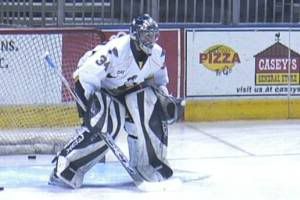 Mentally tough, composed and confident, Bishop is adept at showing opponents a five-hole that looks like the Arch from the blueline, and then closing it up in the blink of an eye. Further, Bishop is also an outstanding puckhandler and offensive catalyst from his crease, often taking advantage of opposition line changes to fire breakout passes to his teammates.
Bishop appeared in five games for the Rivermen last season after completing an outstanding four-year career at the University of Maine, and has already been the subject of some AHL Rookie of the Year speculation. There are still areas of his game that need work -- rebound control and lateral quickness, for example -- but the sky is the limit for Bishop at this point.
Next time in "Tomorrow's Blues," a look at some of the Blues' top NCAA college prospects. Until then, remember... "if we do not prepare for ourselves the role of the hammer, there will be nothing left but that of the anvil." Auf wiedersehen.
(This article was originally featured in "St. Louis Game Time," Vol. 4 No. 4, October 22, 2008 in "Tomorrow's Blues with Brian Weidler")Five games into the 2008-09 AHL season, and the Peoria Rivermen are just about where they want to be.
Currently tied for fourth place in the AHL's West Division, Peoria is one of four teams (the Chicago Wolves, Grand Rapids Griffins and Lake Erie Monsters are the others) in a race for the seventh and eight playoff spots in the Western Conference.
The AHL schedule calls for most games to be played within the division, and the Rivermen epitomize that philosophy so far by having played every game to date within their division. With two wins (vs. Quad City and Milwaukee), two losses (vs. Chicago and Iowa), and an overtime loss to Iowa, the Rivermen are at .500 on the year, and have allowed 15 goals in their five games while scoring 14 of their own.
 Leading the way in goal scoring for the Rivermen is center Julian Talbot. Talbot, signed as a free agent by the Blues last year during a breakout AHL season (24 G, 26 A), leads the way in goals for Peoria with four, three of which have been scored on the power play. Through five games, Talbot's three PP goals account for fully half of Peoria's success with the man advantage; the Rivermen have converted six of 38 chances for a 15.8% mark, which puts the power play right in the middle of the AHL pack.
 Tied with Talbot for the team scoring lead is left wing Steve Regier, a 6'4, 194-pound Edmonton native who signed with the Blues as a free agent in July. Regier, with three goals and five points, has the game-winner in both of Peoria's wins thus far, and has a history of scoring "money" goals in the AHL. Last season with Bridgeport, Regier scored 19 goals in 65 games; five of those were game-winners and ten were scored on the power play. In 2006-07, also with Bridgeport, Regier's 19 goals included another five game-winners, three shorthanded goals and seven on the power play. In 147 games during the last three seasons, Regier has scored 41 goals, 12 of which were game-winners and 17 with the man advantage.
Also checking in with five points through Peoria's first five games is Russian winger Nikolay Lemtyugov. The St. Petersburg product made an impressive AHL debut last year with 22 goals and 37 points in 69 games, and his well-publicized beatdown of Quad City's Tim Ramholt helped him rack up 71 minutes in penalty time as a rookie. Lemtyugov also has a knack for starting strong in games; seven of his 22 goals last year were the first goal of the game.
 This season, Lemtyugov is cementing his position on the Rivermen and in the Blues' organization with another solid start, using his exceptional skating and puckhandling skills to set up goals (four assists in five games). He was teamed with Talbot and AHL veteran Cam Paddock early on, but seems to have settled in with Regier and fellow Blues' draftee Nick Drazenovic in the last few games. Lemtyugov's lone goal this season was, true to type, the first goal of the game in a 3-1 win over Milwaukee last Friday, and was set up by Regier and the AHL-contracted defenseman Jim Jackson.
Drazenovic, a 6' centerman who checks in at 175 pounds, has a pair of assists thus far in five games, and is among the team leaders in penalty time with 14 minutes in the sin bin. In 2007-08, Drazenovic also made an impressive rookie debut, racking up 16 goals and 42 points in 69 games after missing the first couple of weeks while recovering from a bout of mononucleosis. The Prince George, BC native contracted mono during the 2007 Western League playoffs, when he resurrected his fortunes as a Blues' prospect with nine goals and 19 points in 15 games for the hometown Cougars.
Another player looking to brighten his horizons in the Blues' organization is Czech center Tomas Kana, back for another kick at the can in North America after a less-than-auspicious debut in 2007-08. Kana showed up for the Blues' Development Camp in 2007 out of shape, and was assigned to Peoria very early in training camp. The 6', 200-pound center never got into a game with Peoria, and was assigned to Alaska of the ECHL, where he scored two goals in 12 games before bolting back to his Czech homeland. To his credit, Kana played well in the Czech league, with 10 points (5G, 5A) in 25 games spilt between HC Vitkovice and Usti nad Labem, and came to the Blues' main camp this year in better shape, and with a better attitude. Kana is scoreless thus far with the Rivermen, but is playing a key role on the checking/energy line.
Talbot, Regier (at 24 the oldest of the Kiddie Corps), Lemtyugov, Drazenovic and Kana are examples of the Blues' commitment to youth at all levels of the organization, but there's room for veterans -- and the leadership they provide -- in Peoria as well.
31-year-old journeyman Trent Whitfield has been a consummate professional and leader for the Rivermen since signing as a free agent with the Blues in the summer of 2005. He led the Rivermen in scoring in 2006-07 with 33-45-78 totals in 79 games, and last year was fourth on the squad with 22 goals and 52 points while transitioning into a leadership role. This season, Whitfield has earned the "C" for the Rivermen, and leads by example wile still maintaining a presence among the team's scoring leaders with a goal (scored shorthanded vs. Iowa on Oct. 11) and three assists.
Regier, in his fourth AHL season, was awarded one of the alternate captain positions by Rivermen coach Davis Payne, and the other went to fellow free-agent signee and AHL veteran Cam Paddock. Drafted 137th overall by Pittsburgh in 2002, Paddock spent the last couple of seasons in the Phoenix organization. The right-shooting centerman spent the entire 2007-08 season in San Antonio, and hit for 12 goals and 25 points in 71 games. Paddock also showed he could handle the rough stuff on the ice, notching 107 minutes in the sin bin during the regular season, and another 18 minutes in seven playoff games for the Rampage.
This year, Paddock has one goal in five games, scoring in Peoria's home opener on Oct. 11, a 4-3 OT loss to the Iowa Chops. He's also restrained himself thus far in the penalty department, with only a slashing penalty on Oct. 18 at Chicago to blemish his record.
Next time in "Tomorrow's Blues," we'll look at the defense and goaltending of the Rivermen this season. Until then, remember... "if we do not prepare for ourselves the role of the hammer, there will be nothing left but that of the anvil." Auf wiedersehen.
(This article was originally featured in "St. Louis Game Time," Vol. 4 No. 3, October 18, 2008 in "Tomorrow's Blues with Brian Weidler")So far, so good... the Blues have had two home games this year, and won them both by a combined score of 11-3. The young players on the team -- David Perron, Patrik Berglund, T.J. Oshie and 2008 first-rounder Alex Pietrangelo have been big contributors to the team's early success. All of these players have one thing in common besides being members of the Blues; all were first-round picks.
Tonight, our focus will be on the players taken late by the Blues in the 2008 NHL Entry Draft, the players in rounds four through seven. These players may not necessarily be bound for NHL stardom, as is expected of the first-rounders, but there's talent on defense, at forward, and in goal in the Blues' late 2008 picks.
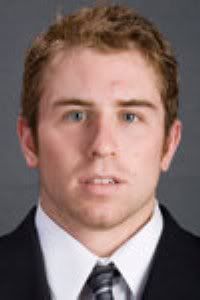 Something of a surprise pick in the fourth round (95th overall) was US National Team Development Program defenseman David Warsofsky. The Blues are known to scout the USNTDP very heavily, but Warsofsky's size -- or lack of it at 5'8 and 160 pounds soaking wet -- has been considered a major strike against him at the defense position.
There are definitely positives to Warsofsky's game, however. Vincent Montalbano at the McKeen's Hockey Prospects website notes that, "despite (his) lack of size, (Warsofsky) is an extraordinary player with exceptional skill, especially on the power play." The mighty mite is, in fact, considered something of a power play specialist, with a one-timer that is especially suited for man-advantage play, and an ability to always find the open man in a power-play situation.
The native of Marshfield, Massachusetts served as the captain of the U-18 squad for the USNTDP, and was second on the squad in scoring with nine goals (three PPG) and 40 points in 56 games. Before being drafted by the Blues, he signed a letter of intent to play at Boston University, and then went to Russia to skate for Team USA at the U-18 World Junior Championships, racking up seven assists and a plus-6 mark in seven games.
McKeens notes that Warsofsky "displays proper positioning on defense, as he does an effective job of cutting down angles and getting in the shooting lanes." The website further notes that he is "not afraid to initiate contact and get in the face of opponents," and that he "does not look to shoot from the point that often, as he prefers to utilize his productive passing game to set up teammates; however, he will pinch at times, as he loves to crash the net and be on the receiving end of a one-timer." Warsofsky has a pair of assists in three games for the Terriers this year, and both have come on special teams (on shorthanded assist and one power-play assist).
In the fifth round, the Blues went back to Europe, and took another offensive-minded defenseman with the 125th overall pick. Kristofer Berglund (no relation to Patrik) became the second defenseman chosen in the last three years by the Blues from IF Björklöven of the Allsvenskan (Alexander Hellström, currently in Peoria, was taken 184th overall by the Blues in 2006).
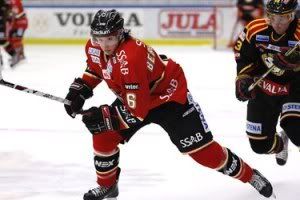 The 5'10, 180-pound native of Umea, Sweden was cited by several of the major scouting services as one of Sweden's top players in the 2008 U-20 World Juniors. McKeens Hockey Prospects called him "an adept puckhandler with excellent anticipation and hockey sense" as well as "a good positional defender (who) knows how to play the body, but (is) by no means a physical player," and said the WJC was a "coming-out party" for him.
International Scouting Services called Berglund "an excellent penalty killer ... who eats up pucks with his stick and skates," and NHL Central Scouting pulled no punches when they called him the "top Swedish d-man at (the) World Junior U20."
Totals of 4-21-25, a plus-10 mark, and 16 minutes in penalty time with Björklöven in 2007-08 earned Berglund a ticket to Luleå HF of the Elitserien for this season, where he's currently 1-3-4 with an even plus-minus and 6 PIM in 12 games.
In round six, the Blues went back to the Ontario League for Guelph Storm center Anthony Nigro. The 6'1, 190-pound Toronto native made great strides in his second Ontario League season in 2007-08, nearly tripling (from 17 to 48) his point totals from his rookie year, and improving from 4 to 24 goals.
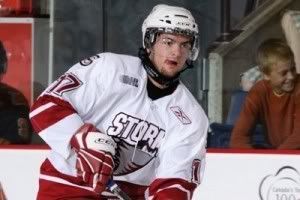 International Scouting Services notes that Nigro "does a few things well, which include jumping into holes and going to the net with his stick on the ice, and working hard for the second and third chances. His defensive side of the game has been excellent, and he is always committed to taking care of that."
In 11 games with Guelph this season, Nigro has four goals and four assists, but is currently in the midst of a six-game scoring drought. His plus-minus is even, and he has 16 minutes in penalty time to go along with a power-play goal and a game-winner (vs. Erie on Sep. 26).
The Blues swung a deal with Los Angeles to re-acquire their seventh-round pick, and spent it on junior "A" goaltender Paul Karpowich of the Wellington Dukes. In 22 games with the Dukes last year, Karpowich posted a 15-3-2 record, a 2.15 GAA and 92.2% save percentage with three shutouts.
Karpowich signed a letter of intent to attend Clarkson this season, and made his NCAA debut Oct. 17 against RIT, stopping 31 of 35 shots to lead the Golden Knights to a 6-4 win. He will likely get the nod again tonight vs. the College Hockey America defending conference champion Niagara Purple Eagles.
In the Clarkson 2008-09 Media Guide, head coach George Roll said, "Paul enjoyed a really good playoff run with Wellington last year and was rewarded by being drafted by the St. Louis Blues this summer. From all indications, he should come in and compete for the number one job. He is a big standup goaltender who handles the puck extremely well."
Next time in "Tomorrow's Blues," we'll take out first look at the Peoria Rivermen, and catch up with the progress of prospects like Ben Bishop and Nikolay Lemtyugov, the number one and number two stars in Peoria's 3-1 win over Milwaukee on Friday night. Until then, remember... "if we do not prepare for ourselves the role of the hammer, there will be nothing left but that of the anvil." Auf wiedersehen.
(This article was originally featured in "St. Louis Game Time," Vol. 4 No. 2, October 16, 2008 in "Tomorrow's Blues with Brian Weidler")Previously in this space, your Game Time Prospect Department gave you the scoop on the Blues' top choices in last June's draft; defenseman Alex Pietrangelo, forward Philip McRae, and goaltender Jake Allen.
Tonight, our focus is on the three players taken by the Blues in the third round of this summer's draft, starting with third-round pick (65th overall), forward Jori Lehtera from Tappara of the Finnish Elite league (SM-Liiga).
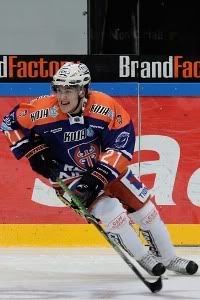 Like 2007 first-rounder David Perron, Lehtera was in his second year of eligibility for the draft when the Blues chose him last summer. Also like Perron, Lehtera is considered a highly-skilled player who is especially proficient at stickhandling. Lehtera was not ranked by any of the major scouting services (NHL Central Scouting, International Scouting Services or McKeens Hockey) in the early or mid-season rankings, but managed to rise to the 23rd spot in the Central Scouting Final European rankings.
The Helsinki-born Lehtera will turn 21 on December 23, and is in his third year with Tappara Tampere of the SM-Liiga, where he broke out last year with 13 goals and 42 points in 54 games, while posting a plus-7 mark and 22 minutes in penalty time. Three years at the elite level makes Lehtera a more mature and developed player than many of his peers in the Blues' organization, but there are the usual concerns about his ability to translate his excellent game in Europe to the smaller North American rink and more physical North American style of play.
Lehtera has NHL size at 6'2, 191, but could stand to develop a little more upper body strength in order to not be checked off the puck in the North American game. He could also stand to further develop his acceleration and top speed, but these negatives are coachable and correctable.
His positives are the things you can't teach; Lehtera has excellent on-ice vision and a good work ethic, and he is an accomplished playmaker who is able to find his wingers from anywhere on the ice. He is a set-up man first and foremost, and will almost always look for the pass instead of taking the shot himself, but his double figures in goals scored during the short Finnish season indicate that he knows how to shoot the puck as well.
Currently, Lehtera is scoring at a point-per-game pace with Tappara, posting two goals and 12 points in 12 games thus far, with a solid plus-6 mark and eight minutes in the sin bin. He's under contract to Tappara through the 2009-10 season, and the Blues are fairly deep at center in the organization right now, so there's no sense of urgency to rush him over to North America just yet. If, however, he continues to round into a solid leader, on the ice as well as on the scoresheet, Lehtera may well find himself poised to make the jump directly to the NHL when some of the Blues' veterans up front are ready to hang 'em up.
 Five picks after the selection of Lehtera, the Blues came back to North America to tap into budding power forward James Livingston, a Nova Scotia native playing into the Ontario Hockey League with Sault Ste. Marie. Livingston, a 6'1, 200-pound right wing, ended the 2007-08 season with 21-23-44 totals, appearing in all 68 games for the Greyhounds and posting a plus-10 with 135 penalty minutes. Four of his 21 goals were scored on the power play, most at the beginning of the year he was a power-play specialist.
Livingston has been described by the McKeens Hockey Prospects website as "somewhere between being a tough guy and a skilled player, but not big or strong enough to be a heavyweight fighter and not good enough hands or skills to be an offensive player at the NHL level." The lack of a defined style in his game was reflected in the way Livingston fluctuated in the rankings by the major scouting services over the 2007-08 season.
Livingston started strong in the McKeens rankings at 14th overall, but by season's end he had dropped in their estimation to 89th overall. International Scouting Services also had Livingston ranked highly (16th overall) at the start of the year, only to see him fall, though not as far (to 39th) as he did at McKeens, and NHL Central Scouting had Livingston at 42nd at mid term and 53rd in the final rankings.
International Scouting Services did note about Livingston that "he works extremely hard every shift on the ice and carries himself with a great deal of class," and the Toronto Star website noted that Livingston "possesses the work ethic, grit and two-way presence to play an important role in the National Hockey League." Currently, Livingston has seven points (2 G, 5 A) in nine games with Sault Ste Marie, with a plus-2 mark and 17 PIM.
The Blues' last selection in the third round (87th overall) was role player Ian Schultz of the Calgary Hitmen. Schultz isn't the biggest guy out there at 6'1, 180 pounds, but he has a heart the size of Montana, with a great work ethic and outstanding leadership traits.
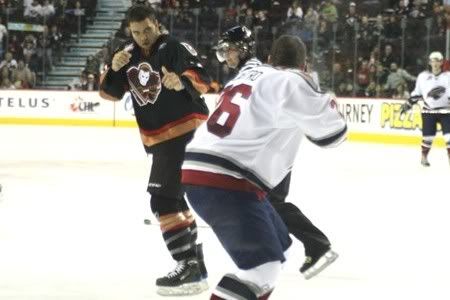 The intangibles, as well as a willingness to get his nose dirty, has resulted in Schultz playing on Calgary's top line over the last few seasons despite modest point totals (15 G, 15 A last year). Schultz spent all of last season on a line with Montreal draftee Ryan White, and is currently playing alongside fellow Blues draft pick Brett Sonne (the 85th overall selection by the Blues in 2007), who leads the Hitmen in scoring and is third in the Western League with 4-11-15 totals in ten games.
McKeens Hockey Prospects website notes that Schultz "has shown flashes of nifty moves and good stickhandling with the confidence to challenge opposing players using his speed and agility." International Scouting Services calls him "very hard-nosed and tough in all aspects of the game," and says he "has the tools to develop into a good power forward in the next few seasons."
Next time in "Tomorrow's Blues," we'll zero in on the Blues' last four 2008 draft selections; offensive-minded defensemen David Warsofsky and Kristoffer Berglund, center Anthony Nigro, and college-bound goalie Paul Karpowich. Until then, remember... "if we do not prepare for ourselves the role of the hammer, there will be nothing left but that of the anvil." Auf wiedersehen.
(This article was originally featured in "St. Louis Game Time," Vol. 4 No. 1, October 10, 2008 in "Tomorrow's Blues with Brian Weidler")In each of the last three seasons, a first-round draft pick has emerged from training camp with a spot on the Blues' NHL roster. In 2006, it was first-overall pick Erik Johnson, as expected. In 2007, the Blues struck gold from Quebec when 26th-overall selection David Perron lived up to his statements in Game Time that he would make the team out of camp, and dazzled teammates, coaches, and fans alike with his skill level.
This year, the hometown boys have yet another first-rounder looking to stick with the big club right out of camp, but the impact on the organization of the Blues' 2008 draft picks doesn't end there. From top to bottom, the Blues came away from Ottawa and the Entry Draft with quality at every position, and tonight we'll take a look at Jarmo Kekalainen's top three selections in this year's draft.
In the first round, with the fourth overall pick, the Blues rolled the dice on blueliner Alex Pietrangelo. The 6' 3, 210-pound native of King City, Ontario put up impressive scoring numbers (13-40-53 in 60 games, with 94 PIM and a sterling plus-29) for the Niagara Ice Dogs, and was playing his best hockey of the season in the playoffs before falling victim to a double whammy of mononucleosis and a ruptured spleen.
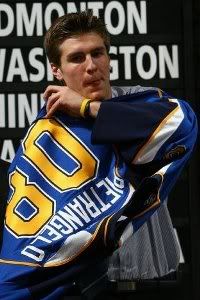 The mono and ruptured spleen kept Pietrangelo out of the workouts at the Scouting Combine, and also kept him off the ice at the annual Development Camp, but the Blues saw enough during the season to rank Pietrangelo at the top of their list for the Entry Draft.
"He's one of the best defensive prospects to come out of the draft since (Chris) Pronger," one NHL scout noted at the McKeens Hockey website, "and he even reminds some of Pronger other than the lack of a mean streak."
"Not many defensemen can offer the total package, and if Pietrangelo puts it all together, he'll be a franchise defenseman for 15 years."
Pietrangelo seems to have recovered fully from the spleen injury and mono, and has earned a spot on the Blues' roster out of training camp. Erik Johnson's injury has opened the door for Pietrangelo to play a lot of minutes early in the season, and if he continues to produce in the regular season as he did in the Blues' pre-season, the expected nine-game trial may well turn into a full-time roster spot.
Shrewd dealing by John Davidson and Larry Pleau left the Blues with back-to-back picks near the top of the second round, and the scouting staff took full advantage of this positioning by selecting Philip McRae of the London Knights (OHL) with the 33rd overall selection, and goaltender Jake Allen of the St. John's Fog Devils (QMJHL) at number 34.
 McRae, son of former Blue Basil McRae, is a streaky player; in December and January of last season, he managed 22 points in 21 games (5 G, 17 A), the followed that performance with a February in which he scored five goals in 13 games, but collected no assists and was a minus-5. He finished the season 18-28-46 in 66 games, a total considered "disappointing" by the staff of the McKeens Hockey Prospect website.
In the U-18 World Juniors, McRae was one of the leaders for Team USA with six points (3 G, 3A) in seven games, but at the USA World Junior Selection Camp in August, he managed only one goal and was generally ineffective.
It was later discovered that the reason for McRae's inconsistent play at the Evaluation Camp was that he had contracted mononucleosis, making him the third high-profile Blues prospect to come down with mono in the last year (Pietrangelo and second-year pro Nicholas Drazenovic are the others). At 6' 2 and 190 pounds, McRae has the size and strength to shake off a bout with mono, and he has returned to the ice in London in dramatic fashion, scoring what turned out to be the game-winning goal in a 4-2 victory over Saginaw last week.
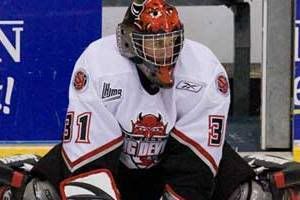 Allen, a native of Fredericton, New Brunswick, was something of a late bloomer. Spending much of the 2007-08 season on the bench in St. John's behind Sharks' prospect Timo Pielmeier, Allen managed to post a nice 2.25 (14 GA in 374 minutes) with a 93.5% save percentage (201 saves) and a 2-2-2 record in his last six games for the 32-30-8 Fog Devils (now playing as Junior de Montréal).
Few expected the 6' 2, 175-pounder with the 8-9-4 record, 3.15 GAA and 90.1% save percentage for the season to make much of a mark in post-season play, but Allen did earn the Devils' only two wins of their first-round series, posting a 3.74 GAA and 85.5% save percentage in the process. Many were stunned when Hockey Canada's chief scout Al Murray included him on Canada's U-18 World Junior entry, but the poised and confident Allen took the opportunity and ran away with it.
Allen played all seven games for Team Canada at the World Juniors, and led his team to the gold medal with a performance made for Hollywood. In 420 minutes, Allen allowed 10 goals on 192 shots for a 1.43 GAA and a 94.8% save percentage. Oh, by the way, he also won six of the seven games, with only a 4-2 loss to host Russia in the preliminary round to mar his record, and posted a pair of shutouts, including an 8-0 whitewashing of the Russians in the championship game.
Allen didn't attend the Blues' Development Camp this year, but did join the team for the Traverse City Prospect Tournament (3.00 GAA, 90.9% save percentage, 1-2-0 record) and even saw action in the NHL pre-season against Los Angeles before being returned to junior. So far this year, Allen has won QMJHL Defensive Player of the Week honors once, and is 4-1-0 with a 2.80 GAA and 91.9% save percentage in five games.
Next time in "Tomorrow's Blues," we'll focus on the Blues' next three selections in June's Entry Draft; Finnish forward Jori Lehtera, budding OHL power forward James Livingston, and grinder Ian Schultz of the Calgary Hitmen. Until then, remember... "if we do not prepare for ourselves the role of the hammer, there will be nothing left but that of the anvil." Auf wiedersehen.
 The Blues' fourth selection (65th overall) in 2008, Lehtera is an older prospect just a few weeks shy of his 21st birthday, but is more physically and mentally mature than the average prospect in the system.
 To say that the 2007-08 season was a disaster for "Ears" would be an understatement.
 Since the 2006-07 season, Berra has played a total of 23 games in the Swiss top league, and has been the backup to a 40-year-old veteran with one club, and to a youngster in his age group for another. This season with HC Davos, Berra has appeared in only five games, sporting a 2-3-0 record, a 2.89 GAA, and an 89.7% save percentage.